DESIGN LANGUAGE BRIEF · WHAT GOOD DESIGN LOOKS LIKE TO APNIC FOUNDATION

They already know what they like.

Research synthesis from three years of APNIC Foundation annual reports (2022–2024), the existing EmpowerTech 2025 country event logos, and APNIC Foundation's digital presence. Their design sensibility is more developed than the 2019 identity guide suggests — and the most important finding is that an EmpowerTech visual identity already exists.
← Back to main preview

EmpowerTech is already a visible brand family.

APNIC Foundation ran six country-level EmpowerTech dialogues across Southeast Asia in 2025 — Timor Leste, Vietnam, Philippines, Thailand, Cambodia, and others. Each had its own event identity using a shared EmpowerTech wordmark system. The 2026 Summit is the synthesis of those dialogues. That means our job is evolution, not invention.
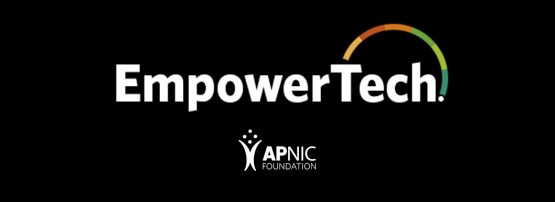
EmpowerTech Timor Leste 2025 Logo
EMPOWERTECH TIMOR LESTE · JULY 2025 · SOURCED FROM BLOG.APNIC.NET

Direction C's horizon metaphor is already in the DNA.

Look at the top of the EmpowerTech wordmark above. A color arc curves from green through yellow to orange — the exact green → gold → orange progression we chose for Direction C's horizon-and-dots system, without having seen this.

We didn't invent this palette journey. We independently converged on it. That's a strong signal our Synthesis Line direction is psychologically correct for this brand family, not a guess.

What the existing EmpowerTech mark tells us

🎯 Strategic implication for our work

  1. Preserve "EmpowerTech" as a wordmark. Don't reinvent it. The brand equity is already in market.
  2. Our Summit 2026 mark is a modifier on EmpowerTech — adding "SUMMIT 2026", the Bangkok location, and the synthesis-moment gravitas.
  3. The green → yellow → orange spectrum is theirs. Direction C should lean into this harder — not as a copy, but as a recognizable continuity from the 2025 dialogue series.
  4. The 2025 country events were the "Evidence" beat of our agenda arc. The 2026 Summit is the "Synthesis" beat. That's a beautiful narrative we can tell the client explicitly.

Their annual reports are sophisticated editorial design.

Three years of annual reports (2022, 2023, 2024) are in the repo at reference/apnic-design-examples/. They reveal a design system much more developed than the 2019 identity guide suggests. Here's what stayed consistent across all three years.

CONSISTENT ACROSS 2022–2024

The vertical green column with white APNIC Foundation mark is the signature device.

Every annual report cover: full-bleed documentary photo on the left, solid green column on the right, APNIC Foundation logo reversed to white, year + "ANNUAL REPORT" set large in white. It's a wallpaper-grade visual identity choice — instantly recognizable.

Implication for Summit 2026 signage/backdrop: the vertical green column + white type is a proven template we can adapt for hotel entrance signage or stage backdrop.

THREE-PROGRAM COLOR SYSTEM

They already use four colors, not one.

The annual reports have been using a three-program color coding for years — Infrastructure, Knowledge, Inclusion — each with its own hue:

INFRASTRUCTURE
KNOWLEDGE
INCLUSION
FOUNDATION (parent)

This matches what the "new palette" document is codifying. Their 2024 report has full pages bathed in orange, red, or deep green based on which program is being showcased. The new palette isn't new — it's documentation of what's already in practice.

CUSTOM ICON LANGUAGE

They have a category icon system with colored circular containers.

Every program has a custom icon in a colored circle: signal waves for Infrastructure (orange), lightbulb for Knowledge (red), 8-pointed gear for Inclusion (orange). Plus the figure-with-dots icon reused small as the "Foundation-led project" mark, and an orange location pin for geography.

Implication for our four-beat agenda: we can design custom icons for Evidence / Curation / Bridge / Synthesis in matching colored circles — this would feel immediately native to the brand family.

DATA CALLOUTS IN CIRCLES

Numbers are treated as visual events, not just text.

Metrics like "22.4 million", "4,630", "USD 9,254,623" appear in colored circular badges alongside descriptive text. It's a signature treatment that reads as "the data matters here, pay attention."

Implication: Our "700M people · 22% offline · 35% lack meaningful connectivity · 6 economies · 1 blueprint" stats deserve the same treatment on the Summit social tile, hotel signage, or opening-sequence frames.

They photograph like a documentary journal, not an NGO brochure.

This is the most important under-appreciated signal in their existing work. Their photography style isn't "corporate NGO" or "stock optimism" — it's grounded, contextual, and specific.

WHAT IS IN THEIR PHOTOS

Real grassroots people doing real work. Pacific Islanders on scaffolding. Women in hijabs at conferences with mic in hand. ISIF grantees in branded t-shirts mid-presentation. Rural Samoa training sessions. Kids outside a Taiwanese satellite deployment.

WHAT IS NOT IN THEIR PHOTOS

No hands-shaking diversity shots. No conference-room-glass-skyscraper stock. No glossy post-production. No speaker-at-podium-from-below hero angles. No handshake-across-globe tropes.

TONE

Warm natural light. Honest framing. Subjects mid-gesture or mid-thought, not posed. Color in clothing and environment (batik, prints, rural contexts). Documentary photojournalism rather than marketing photography.

LAYOUT MOVE

Full-bleed photos paired with text blocks, often with a colored overlay on one edge. They let images breathe at large scale — not thumbnail-sized proof-points.

Implication for Summit 2026 collateral

Event photography on the day should match this documentary register. Whoever shoots the Summit needs a brief that says: real faces mid-conversation, grassroots partners in front of the backdrop, minister-in-dialogue-not-in-pose. APNIC will recognize good photography instantly because they already do it — and reject stock-ish alternatives.

Any stock imagery in signage or digital screens (hotel wayfinding, opening slideshow, speaker-waiting backgrounds) should lean toward their existing photo library's register, not toward generic SEA tourism or "digital transformation" cliché shots.

The Geist transition is happening now.

The 2022–2024 Annual Reports use a bold humanist sans-serif (looks like Avenir, Proxima Nova, or similar) for headers and body. Geist is new — specified in the latest brand guidelines but not yet rolled across legacy materials. Our work for the Summit is part of that transition.

Six concrete moves to sharpen before Monday.

  1. Incorporate the EmpowerTech color arc into Direction C. The 2025 country-event logos all have a green→yellow→orange arc above the "EmpowerTech" wordmark. If our Summit 2026 mark references or evolves that arc, it reads as visible lineage with the 2025 dialogue series — the client will recognize it as a respectful evolution, not a pitch-over-the-top.
  2. Consider keeping "EmpowerTech" as-is and adding "SUMMIT 2026" as a modifier. The brand equity in the EmpowerTech wordmark already exists. Our Summit mark might be: [existing EmpowerTech wordmark + arc] + [subordinate "SUMMIT 2026" · BANGKOK treatment]. This is a less risky proposition for the client than a new wordmark entirely.
  3. Design four custom agenda-beat icons in colored circles matching their existing program-icon pattern. Evidence / Curation / Bridge / Synthesis as a set. This would go on the social tile, on signage wayfinding, and as transition graphics in Tati's motion work.
  4. Build the vertical green column + white wordmark variant for portrait applications (rollup banners, photo backdrop anchor, IG Stories). It's their proven annual-report move and it will feel immediately native.
  5. Brief any event photographer explicitly on the documentary aesthetic. Not "corporate summit coverage." This also shapes the Tuesday tile — any supporting imagery should feel like it could appear in their 2026 Annual Report next year.
  6. Use data-in-circles for the Summit's signature stats — "700M · 22% offline · 6 economies · 1 blueprint" deserves the callout treatment on the social tile, opening sequence, and stage graphic.
BACK TO MAIN PREVIEW VIEW PEER LOGO MOODBOARD